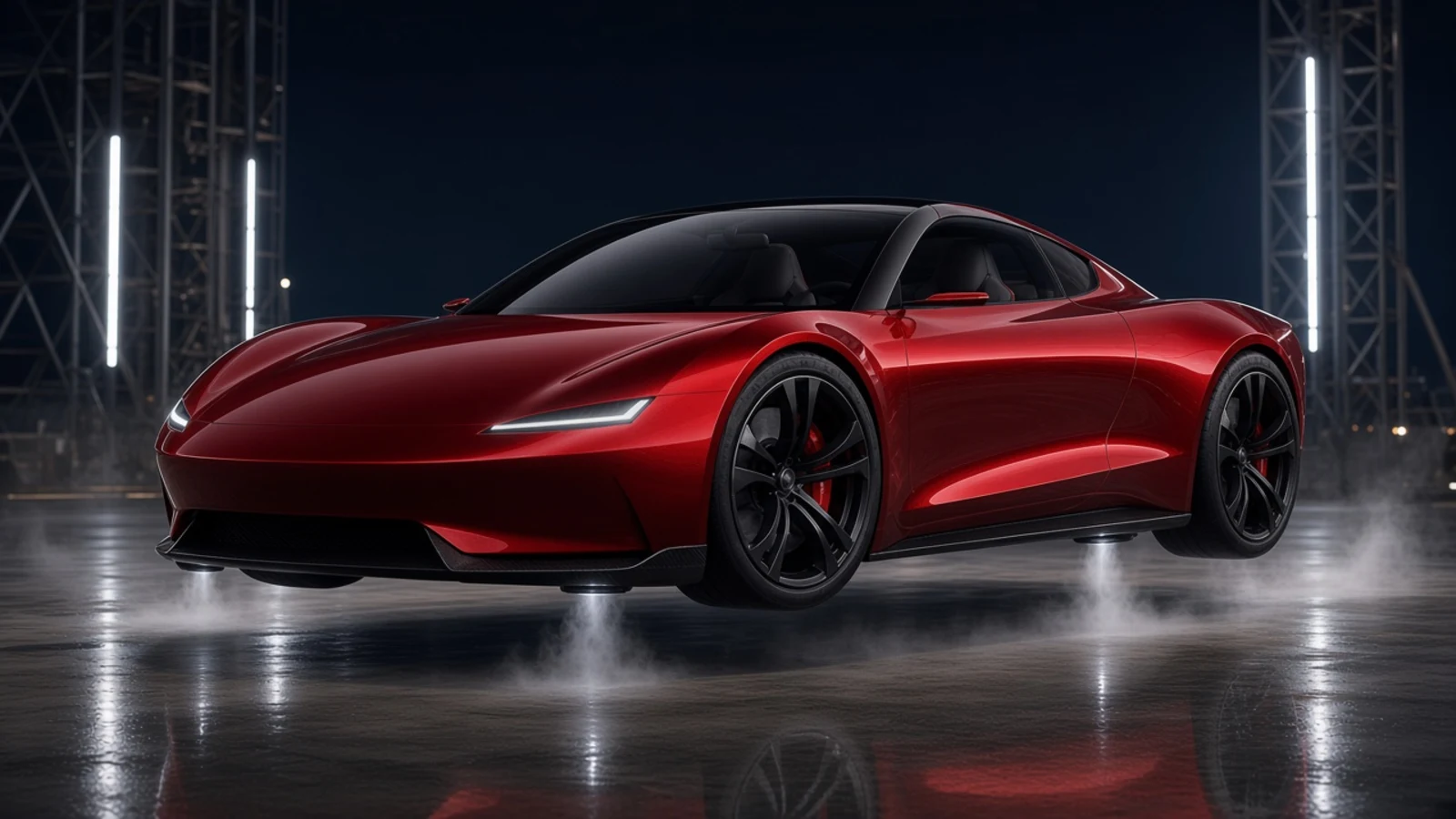
The most interesting thing about the next-generation Tesla Roadster is not that it might briefly leave the ground. It is that Tesla appears to be attacking the oldest ceiling in performance cars — how much force a tire can transmit to the road — using three different physical mechanisms at once: electric motors, active fan-generated downforce, and SpaceX-built cold-gas thrusters.
What actually happens on October 1
On September 13, 2026, Tesla posted an image of a Roadster lit like a vehicle on a launch pad, stamped 10.01 and captioned “Go for launch.” A countdown appeared on Tesla’s Roadster page. Invitations then went out to reservation holders.
| Detail | What is known | Confidence |
|---|---|---|
| Date and time | October 1, 2026, 8:30 p.m. Eastern | Tesla teaser and countdown; invitations |
| Location | Waco, Texas, roughly 90 minutes north of Tesla’s Austin headquarters | Reservation-holder invitations reported by Teslarati |
| Entry | RSVP required by September 16; guests 21 and older; non-transferable | Reported invitation terms |
| Main attraction | The SpaceX thruster package, reportedly code-named A71 | Press reporting, not an official Tesla spec |
| Demonstration format | Remotely operated, nobody inside, spectators kept several hundred yards back | The Information, via Electrek and others |
| Production timing | Musk has said production would likely start 12–18 months after the reveal, pointing to 2027–2028 | Musk statements and subsequent reporting |
The distinction matters: October 1 is a reveal and demonstration, not a launch of sales or deliveries. Tesla has not published a conventional production specification for the car.
Forget the 2017 numbers
Tesla showed a second-generation Roadster prototype at the end of the Semi event in November 2017. The Roadster page has carried the same figures ever since: 0–60 mph in about 1.9 seconds, a top speed above 250 mph, roughly 620 miles of range, and four seats.
Nearly nine years later, those numbers no longer describe a category leader. Tesla’s own Model S Plaid brought sub-two-second acceleration into a production sedan, and the electric hypercar field has filled in around the original claim. Musk has said the design goals were “radically increased,” and has called a sub-one-second 0–60 “the least interesting part” — which only makes sense if something other than raw acceleration is the point.
Two other things have changed since 2017. Reporting describes a running two-seat prototype with butterfly doors built in late 2025, and Tesla filed new Roadster-related trademarks in May 2026. Neither is a spec sheet, but both suggest a program that moved from slideware to hardware.
A71: the SR-71 Blackbird tribute
According to The Information, with details carried by Electrek and Teslarati, the thruster package is internally code-named A71, a reference to the Lockheed SR-71 Blackbird.
The naming is a useful tell about the car’s personality. The SR-71 was not designed to be comfortable, efficient, or commercially sensible. It was designed to outrun everything, and it made brutal engineering trades to get there — famously leaking fuel on the ground because its panels were sized to seal only once heat expansion took hold at speed. It is a machine whose design brief was the limit itself.
The same reporting describes a styling process that passed through a Lamborghini Countach-influenced phase favored by design chief Franz von Holzhausen, then shifted toward evoking the SR-71 at Musk’s direction — which is where the code name comes from — before settling into a more restrained shape by 2025. Tesla also brought in body-engineering talent from the Italian supercar world, including former Lamborghini body engineering head Stefan Nothdurfter.
A practical consequence: if the production car lands anywhere near that brief, expect an aircraft-like surface language — a very low stance, aggressive functional intakes and extraction vents, and sealed underbody detail. That is a different canvas from a Model 3 or Model Y, and it is worth keeping in mind if you are used to designing wraps on relatively flat, forgiving body panels.
The real bottleneck is the tire, not the motor
Suppose the target really is a 0–60 mph time near one second. Sixty mph is about 26.8 m/s, so reaching it in one second requires an average acceleration around 2.7 g — and because that is an average, instantaneous peaks have to be higher. Musk’s quoted figure for the thruster car, roughly 1.1 seconds at about 2.75 g, sits in the same range.
The intuitive response is “just add more power.” That misreads the problem. Longitudinal acceleration is limited by the friction force available at the contact patch, which depends on the coefficient of friction and the normal force pressing the tire into the road. Past that limit, extra motor torque produces wheelspin, heat, and smoke — not a faster run.
The question is not “how much power can the motors make?” It is “on what authority do the tires put that power into the ground?”
So the interesting engineering problem becomes almost counterintuitive: how do you press the tires hard into the road while the car is nearly stationary? Conventional aerodynamics cannot help. Wings and diffusers make downforce from airflow, and airflow scales with speed. At the launch line there is almost no airflow, so there is almost no aerodynamic downforce, exactly when you need grip most.
Mechanism one: suck the car onto the road
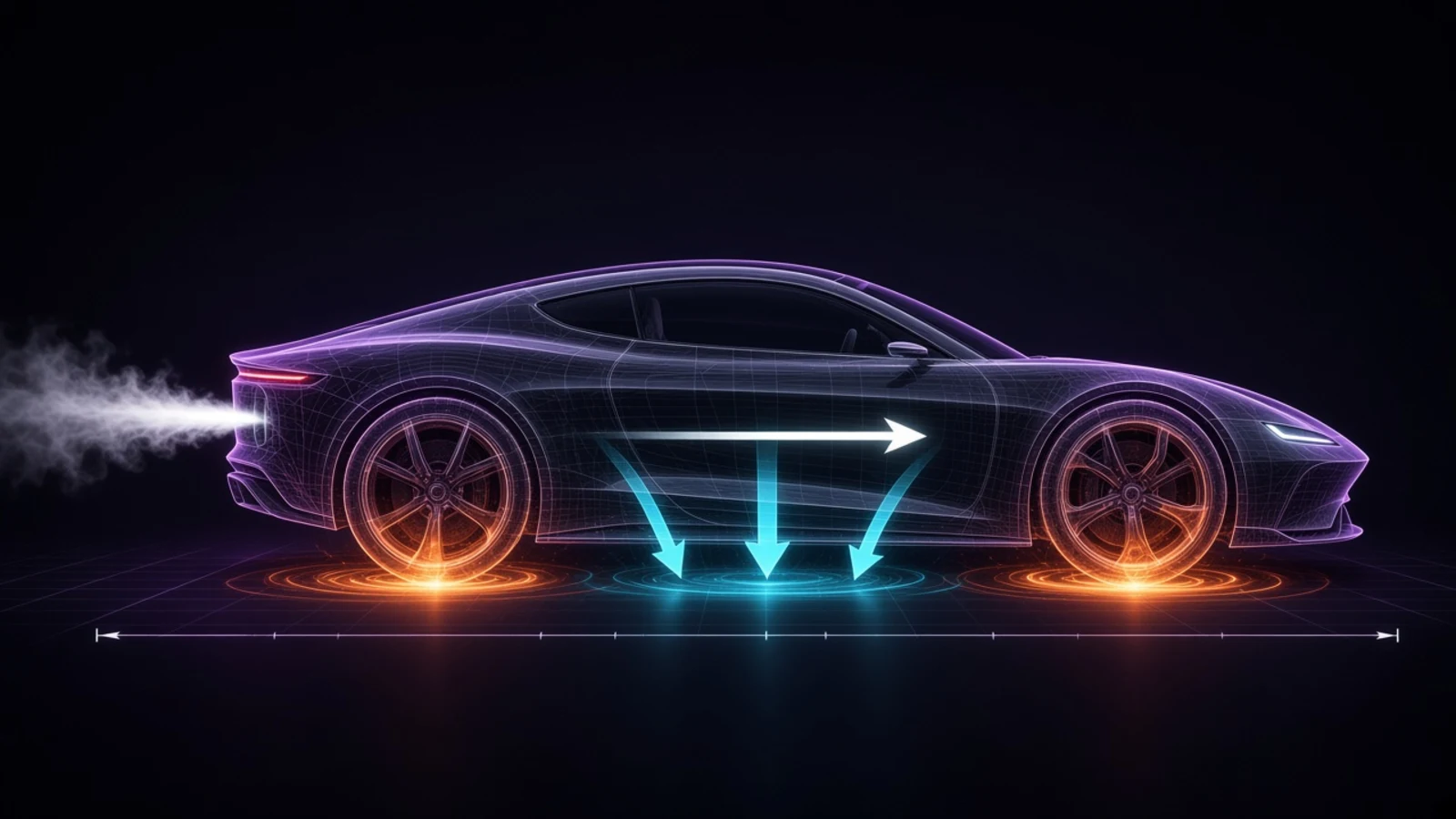
On August 5, 2025, the USPTO granted Tesla patent US 12,377,920 B1, titled “Adaptive vehicle aerodynamics for downforce.” The published abstract describes a system with two operating modes:
- Multiple fans positioned in airflow pathways that move air out from beneath the car.
- Deployable skirts that interact with the ground to bound a low-pressure region under the vehicle.
- A first mode in which a complete set of skirts creates a fully sealed region, with central fans generating maximum downforce at low speeds on smooth surfaces.
- A second mode in which only a subset of skirts (primarily the side skirts) is deployed and all fans operate, trading peak downforce for tolerance of uneven surfaces at higher speed.
- A control mechanism that selects skirt configuration and fan operation based on detected driving conditions.
The physical idea is straightforward. Remove air from a sealed volume under the car and the pressure there drops; the atmosphere above continues pushing down at roughly 101 kPa. The resulting force is pressure difference multiplied by area, and critically, it does not depend on road speed. The car can be standing still and still be pressed onto the pavement.
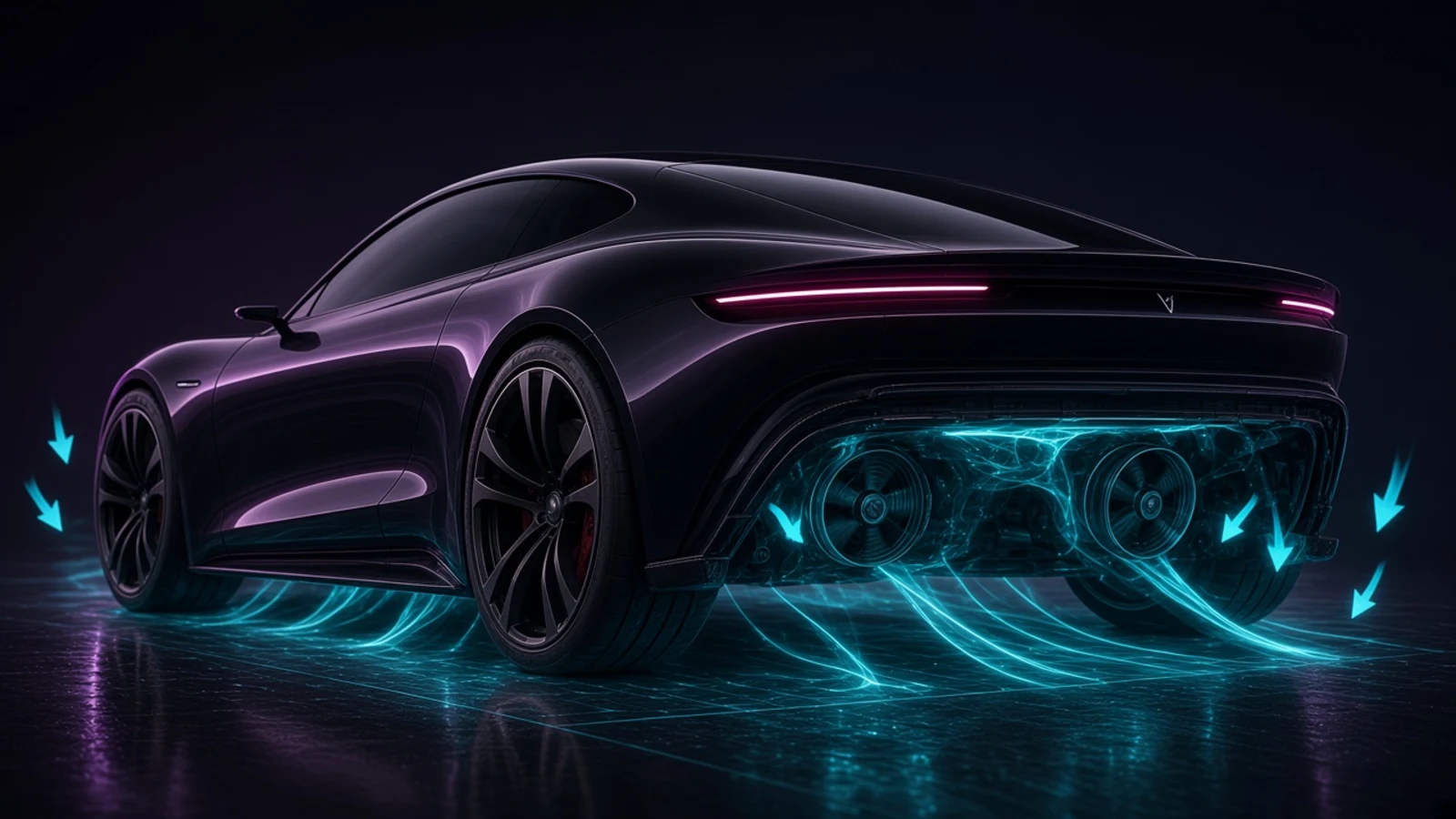
This is old and proven territory. The Chaparral 2J ran auxiliary fans and skirts in Can-Am in 1970. The Brabham BT46B won its only Formula 1 start in 1978 and was withdrawn shortly after; ground-effect skirts were later banned outright. More recently the McMurtry Spéirling has pushed fan-generated suction to the point of public demonstrations of the car adhering upside down.
What is distinctive in Tesla’s filing is not the fan. It is the emphasis on software-selected, multi-mode behavior — varying skirt deployment and fan operation according to conditions, rather than a single fixed suction setup. That is a very Tesla way to frame a mechanical problem.
Important caveat: a granted patent documents an idea the company thought worth protecting. It is not a production configuration. Tesla has not confirmed that a fan downforce system appears on any Roadster you can buy.
Mechanism two: push the body directly
“SpaceX thrusters” suggests fire and combustion. The reported technology is quieter conceptually, if not acoustically: cold-gas thrusters.
- Gas — nitrogen or highly compressed air — is stored at very high pressure in a composite overwrapped pressure vessel (COPV), the same class of tank SpaceX uses on Falcon 9.
- When thrust is wanted, a valve opens and the gas accelerates out through a nozzle.
- By Newton’s third law, expelling mass in one direction pushes the vehicle in the other.
- Nothing is burned or ignited, which is why it is called cold gas.
Spacecraft have used exactly this for attitude control for decades. The advantages are simplicity, fast response, and precise pulsing. The drawback is that specific impulse is low: you must carry a lot of gas, and when it runs out, the thrust stops. That makes cold gas unsuitable for sustained flight and very well suited to something else — a short, decisive intervention.
Here is why that intervention is conceptually different from every other performance upgrade. A bigger motor, a better battery, stickier tires, more aggressive launch control: all of it still routes force through the tire–road interface. A thruster does not. It applies force to the car body directly, so it can keep adding acceleration after the tires have already saturated. Musk’s original 2018 description — around ten small thrusters arranged around the car, improving acceleration, top speed, braking, and cornering — fits that logic in every axis, not just straight-line launch.
Reporting also sets expectations about what this version of the car will be. The thrusters are described as loud enough to risk hearing damage, the demonstration as remotely operated with nobody inside, and the thruster-equipped car as likely not street legal — discussed as a limited, track-only program distinct from the standard Roadster. Forbes has raised the obvious regulatory questions: what a high-pressure gas discharge system means for road certification, bystander safety, and debris is genuinely unresolved.
Three mechanisms, one car
Put together, the engineering story becomes much sharper than “Tesla made a flying car.”
| Layer | Mechanism | What it does | Evidence strength |
|---|---|---|---|
| 1. Electric motors | High torque at the wheels | Delivers force through the tire contact patch | Proven Tesla capability, shipping today |
| 2. Active aerodynamics | Underbody fans plus deployable skirts | Raises the grip ceiling, including at low speed | Granted patent; production use unconfirmed |
| 3. Cold-gas thrusters | Gas expelled through nozzles | Adds force to the body, bypassing the tires | Official teasing plus press reporting; details unverified |
Layer one pushes through the tires. Layer two increases how much the tires can take. Layer three stops asking the tires for permission. The number worth caring about is not 3,000 or 4,000 horsepower — it is that three unrelated branches of physics are being pointed at the same car.
So can it fly? A reality check
A rough order-of-magnitude estimate is enough to bound the question. This is our own back-of-the-envelope arithmetic, not a Tesla figure.
- Assume a curb mass around 1,800 kg.
- Hovering requires thrust roughly equal to weight: about 17.7 kN.
- Cold-gas systems have effective exhaust velocities in the low hundreds of meters per second — call it 600–700 m/s for nitrogen.
- Required mass flow is thrust divided by exhaust velocity: on the order of 25–30 kg of gas per second.
Even with an aggressive COPV installation — and reporting suggests tanks large enough to displace seats — sustainable hover time lands in the single-digit seconds. That is consistent with reports that the demonstration was scaled back from earlier, wilder concepts toward a brief lift off the ground.
So: not five minutes of flight, and certainly not urban air mobility. “Flying” is a short demonstration, a launch-assist trick, and a marketing symbol. The part that could actually change how hypercars are engineered is the combination that raises and then sidesteps the grip limit.
What it means for Tesla owners and designers
- Watch the grip story, not the hover clip. Active downforce, composite structure, and Tesla–SpaceX engineering transfer are the durable parts of this program.
- Tires and pavement remain the final judge. Friction and normal force govern every road car, and the fan patent is a direct attack on that boundary.
- The design language will likely read as aircraft, not GT. Lower stance, more extreme aerodynamic surfaces, functional intakes and extraction — a very different surface to work with than today’s Tesla lineup.
- Demonstration and production are separate things. A stunt car is not a trim level, and a patent is not an options list.
- Timelines have moved before. Tesla has shifted Roadster dates repeatedly since 2020. Keep “October 1 reveal” and “2027–2028 production” in separate mental boxes.
If you want to experiment with how a Roadster-style body reads with different finishes, we maintain an interactive 3D Tesla Roadster wrap preview built on a prototype body, with a clear disclosure that no official UV template exists yet. For vehicles Tesla does support today, the wrap editor and the community gallery work against the real Paint Shop templates.
Frequently asked questions
What is the Tesla Roadster A71?
A71 is the reported internal code name for the SpaceX-developed thruster package for the next-generation Roadster, a nod to the Lockheed SR-71 Blackbird. It is described as cold-gas thrusters fed by a composite overwrapped pressure vessel, the same class of tank SpaceX uses on Falcon 9. Tesla has not published an official A71 specification.
When is the Tesla Roadster being revealed?
October 1, 2026 at 8:30 p.m. Eastern, in Waco, Texas according to invitations sent to reservation holders, with RSVPs due September 16 and entry limited to guests 21 and older. It is a reveal and demonstration, not the start of deliveries.
Will the Tesla Roadster actually fly?
Not meaningfully. Reporting describes a brief lift off the ground during a remotely operated demonstration with nobody inside. Cold gas has low specific impulse, so a car-sized vehicle would consume tens of kilograms of stored gas per second to hover. Any hover is measured in seconds.
Why do thrusters help acceleration at all?
Because every other car must push its power through the tire contact patch, and past the friction limit more power just means wheelspin. A thruster applies force to the body directly, adding acceleration without asking more of the tires.
Has Tesla patented a fan car?
Yes. US 12,377,920 B1, “Adaptive vehicle aerodynamics for downforce,” was granted on August 5, 2025. It covers fans plus deployable skirts sealing a low-pressure underbody region, with a fully sealed low-speed mode and a partially sealed mode for uneven terrain. A patent is evidence of intent, not a production configuration.
Can I buy a Roadster with the SpaceX package?
Probably not as a road car. Reports describe the thruster version as non-street-legal and discussed as a limited, track-only program separate from the standard Roadster. Tesla has not confirmed trims, pricing, or availability.
Sources and disclosure
Primary and secondary sources reviewed for this article, as of September 22, 2026: Tesla’s official Roadster page; USPTO grant US 12,377,920 B1; Electrek on the remotely operated demonstration and A71 naming; Teslarati on the event date, venue, and COPV description; Forbes on regulatory and safety questions; and Teslarati’s patent analysis connecting the aerodynamics filing to the acceleration target.
This is independent commentary compiled from public sources. Tesla Wrap Designer is not affiliated with Tesla, Inc. or SpaceX. Internal code names, unreleased configurations, and demonstration details are attributed to press reporting rather than official specification, and physical estimates are labeled as our own. Refer to Tesla’s official announcements for final figures.